Let's play a quick game.
Open a new browser tab. Count how many business apps you're currently logged into. Slack. Trello. Asana. Google Drive. Zoom. HubSpot. QuickBooks. Monday.com. Notion. The list goes on.
Done counting? If you hit double digits, you're not alone.
Most businesses today run on a patchwork of apps. One for communication. Another for project management. A third for invoicing. A fourth for HR. And somehow, they're all supposed to "integrate seamlessly."
Spoiler alert: they don't.
Here's the truth nobody wants to admit. More apps don't equal more productivity. In fact, they often do the opposite.
The Hidden Tax You're Paying Every Day
Every time you switch from Slack to Trello to your email, something happens in your brain. It's called context switching. And it's silently eating away at your productivity.
A Harvard Business Review study found something alarming. Workers spend roughly 9% of their work week just toggling between applications. That's almost half a day every week. Gone. Poof. Vanished into the digital void.
Think about that for a second.
You're paying for all these apps to make you more efficient. But you're losing nearly 4 hours a week just jumping between them.

The Real Cost of Your App Collection
Let's talk money. Because this is where things get uncomfortable.
That project management tool? $15 per user per month. The CRM? $25 per user. Communication platform? $12. HR software? $8. Time tracking? $10. Invoicing? $20.
Add it up. For a team of just 10 people, you're looking at $900 per month. That's $10,800 a year. On apps that don't talk to each other.
But wait. There's more.
The hidden costs nobody mentions:
- Training time for each new platform
- IT support for integration headaches
- Lost productivity from app-hopping
- Subscription creep (those "free trials" that auto-renew)
- Data scattered across a dozen different databases
Suddenly, that "affordable" software stack doesn't look so affordable anymore.
The Mental Fatigue Factor
Here's something the productivity gurus don't talk about enough. App overload is exhausting.
Every app has its own:
- Login credentials
- Interface to learn
- Notification settings
- Mobile app to download
- Update schedule to manage
Your brain wasn't designed for this. It's like asking someone to speak 10 different languages in a single conversation.
Research shows employees spend only 39% of their time on actual role-specific tasks. The rest? Administrative overhead. Switching contexts. Searching for information spread across multiple platforms.
That's not working. That's digital busywork.

The Integration Myth
"But our apps integrate!" you might say.
Sure. Some do. Kind of.
Here's what integration usually looks like in reality:
- You pay extra for the "Pro" plan that includes integrations
- You spend hours setting up Zapier workflows
- Something breaks
- You troubleshoot for half a day
- It works for two weeks
- An app updates and breaks everything again
- Repeat
Native integrations are rarely native. They're duct tape solutions marketed as seamless connections.
And every integration point is a potential failure point. More apps mean more things that can go wrong.
What Smart Businesses Are Doing Instead
The smartest companies are moving in the opposite direction. They're consolidating. Simplifying. Centralizing.
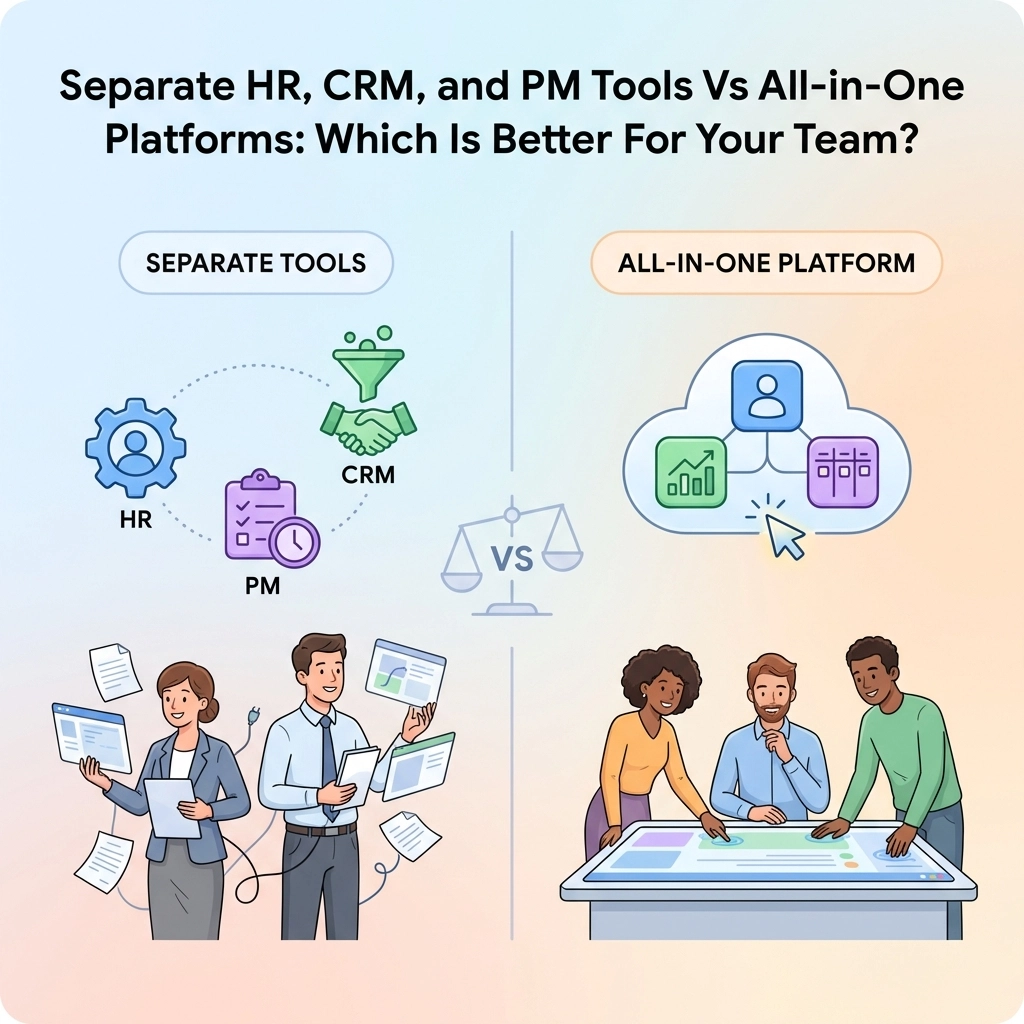
Instead of 10 apps doing 10 things poorly, they're choosing one platform that does everything well.
Think about it this way.
Would you rather have:
- A Swiss Army knife with 50 tools (most of which you'll never use)
- Or a well-designed multi-tool that handles your actual daily needs perfectly
The answer seems obvious when you frame it that way.

The Power of One Platform
When everything lives in one place, magical things happen.
Your data stays connected. Customer information flows naturally from sales to support to invoicing. No manual exports. No copy-paste nightmares. No "which spreadsheet has the latest numbers?"
Your team stays aligned. Everyone sees the same information. No more "I sent that in Slack" or "Check the Trello board" or "It's in the shared drive somewhere."
Your costs become predictable. One subscription. One bill. One training program. One support contact.
Your brain gets a break. One interface to master. One set of notifications to manage. One place to check every morning.
This isn't just about convenience. It's about sanity.
How to Know If You Have an App Problem
Still not sure if your app stack is holding you back? Here are some warning signs:
- You can't remember passwords for half your tools
- New employees take weeks to get up to speed on all your systems
- Important information "falls through the cracks" between platforms
- You've said "let me check [app name]" more than five times today
- Your monthly software bill gives you mild anxiety
- You have apps you're paying for but haven't opened in months
Sound familiar? You're not alone. Most growing businesses fall into this trap.
The TeamsMaster Approach
This is exactly why we built TeamsMaster.
One platform. Everything you need. Nothing you don't.
Project management. Team communication. HR essentials. Client management. Time tracking. Invoicing. All living under one roof.
No more app-hopping. No more integration nightmares. No more subscription spreadsheets.
Just your work. Organized. Simplified. Actually manageable.

Making the Switch: It's Easier Than You Think
"But we've already invested so much in our current tools!"
This is the sunk cost fallacy talking. And it's keeping you stuck.
Yes, switching takes effort upfront. But consider the alternative. Another year of:
- Wasted hours toggling between apps
- Mounting subscription costs
- Frustrated team members
- Lost data and miscommunication
The short-term pain of consolidation is nothing compared to the long-term pain of staying scattered.
The Bottom Line
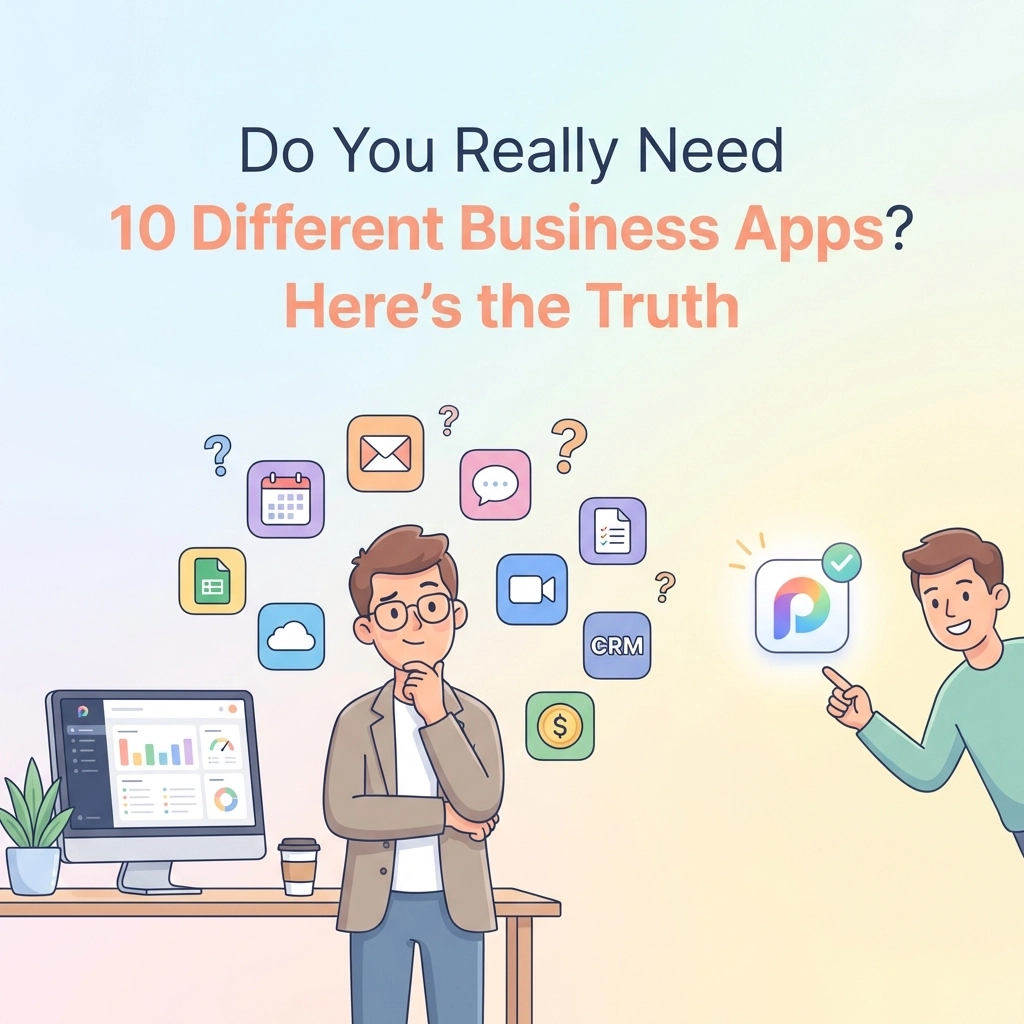
Do you really need 10 different business apps?
No. You probably don't.
What you need is one good system that handles your core workflows. One place where your team can collaborate, communicate, and get things done.
The businesses winning today aren't the ones with the most tools. They're the ones with the right tools. Often, that means fewer tools. Better integrated. Actually used.
Simplicity isn't a limitation. It's a competitive advantage.
Your team deserves better than a Frankenstein stack of disconnected apps. Your budget deserves better. Your sanity deserves better.
Maybe it's time to stop adding apps. And start subtracting them.
Ready to simplify your business operations? TeamsMaster brings everything together in one clean, powerful platform. No more app chaos. Just work that flows.