Picture this.
It's Monday morning. You need to check a client invoice. So you open your accounting app. But wait, the project details are in your project management tool. The client's contact info? That's in your CRM. The original quote? Buried somewhere in your email.
Four apps. One simple task. Twenty minutes gone.
Sound familiar?
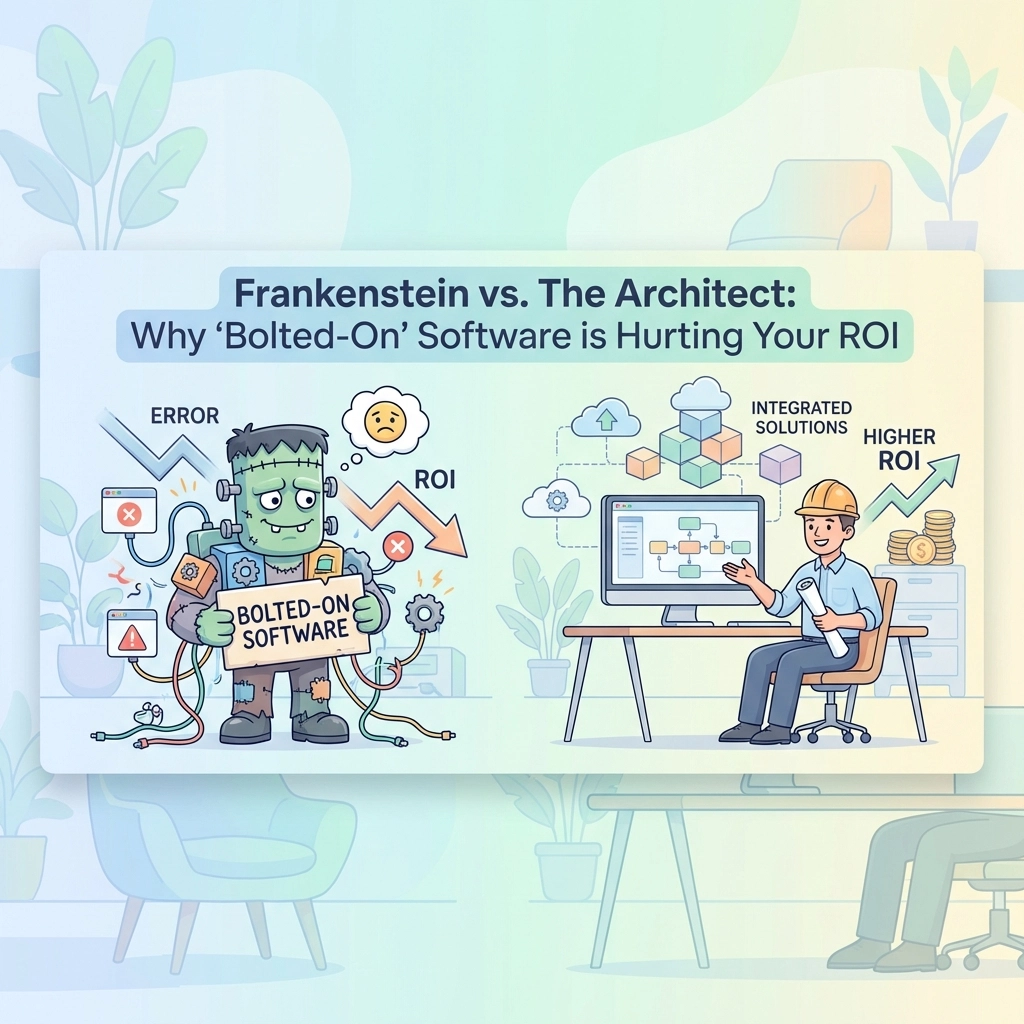
If your business runs on a patchwork of disconnected tools, you've built yourself a monster. A digital Frankenstein. And it's quietly eating your profits.
What Exactly Is "Frankenstein Software"?
Frankenstein software isn't one bad app. It's what happens when you bolt together a bunch of "good" apps without a plan.
You started with a free project tracker. Then added a separate invoicing tool. Then a communication app. Then a CRM. Then a scheduling system. Then a file storage solution.
Each tool solved one problem. But together? They created ten new ones.

Here's the thing. Frankenstein systems don't start ugly. They start as elegant solutions. A tool here, an integration there. Everything seems fine.
But over time, the stitches start showing.
Data lives in silos. Nothing talks to each other. Your team wastes hours copying information between platforms. And you? You're paying for six subscriptions when you only needed one.
That's the Frankenstein trap.
5 Signs You're Running a Frankenstein Operation
Not sure if this applies to you? Here are the warning signs:
1. You're constantly switching tabs.
If completing one task requires three different logins, you've got a problem.
2. Your data doesn't match.
The client's address in your CRM says one thing. Your invoicing tool says another. Which one is right? Nobody knows.
3. Your team asks "where do I find this?" daily.
When information is scattered, confusion becomes the norm.
4. You're paying for features you already have.
That fancy reporting tool? Your project manager already has reporting. You just didn't know.
5. Onboarding new employees takes forever.
Teaching someone six different systems is exhausting. For you and for them.
If you nodded at three or more, congratulations. You've built a monster.
The Real Cost of Bolted-On Software
Let's talk money. Because that's what ROI is really about.
Frankenstein software doesn't just waste time. It bleeds cash in ways you don't immediately see.
The Subscription Stack
The average small business uses 40+ different software tools. Forty. Each one has a monthly fee. Some charge per user. Others charge for storage. A few charge for both.
Add it all up. You might be spending thousands per month on tools that overlap, conflict, or sit unused.
The Productivity Tax
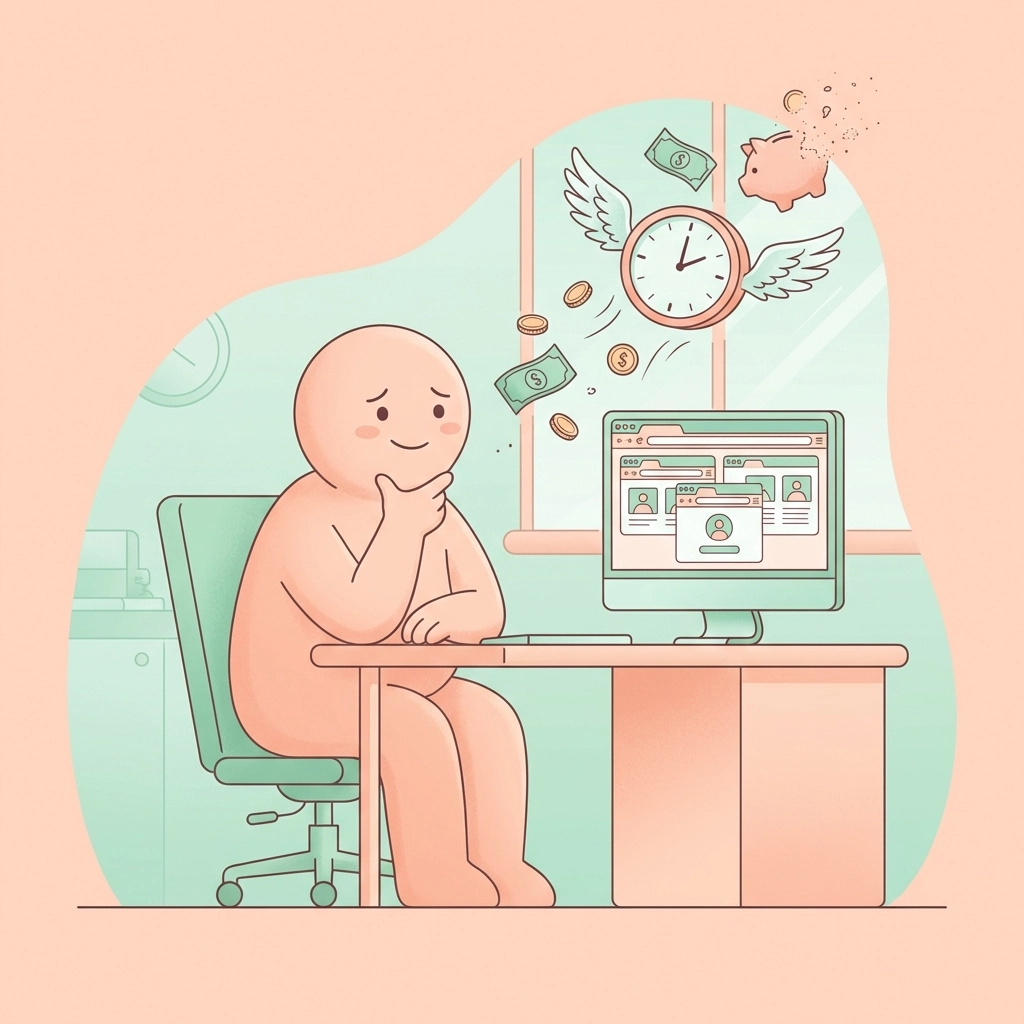
Every time your team switches between apps, they lose focus. Studies show it takes over 20 minutes to regain concentration after a context switch.
Do the math. If your team switches apps 10 times a day, that's hours of lost productivity. Every single day.
The Error Multiplier
When data lives in multiple places, mistakes multiply. Wrong invoices get sent. Deadlines get missed. Clients get frustrated.
And fixing those mistakes? That costs money too.
The Hidden Training Cost
New hire joins your team. Now they need to learn your project tool. And your communication app. And your CRM. And your invoicing system. And your file storage.
That's not onboarding. That's overwhelm.
Enter The Architect Approach
Now let's flip the script.
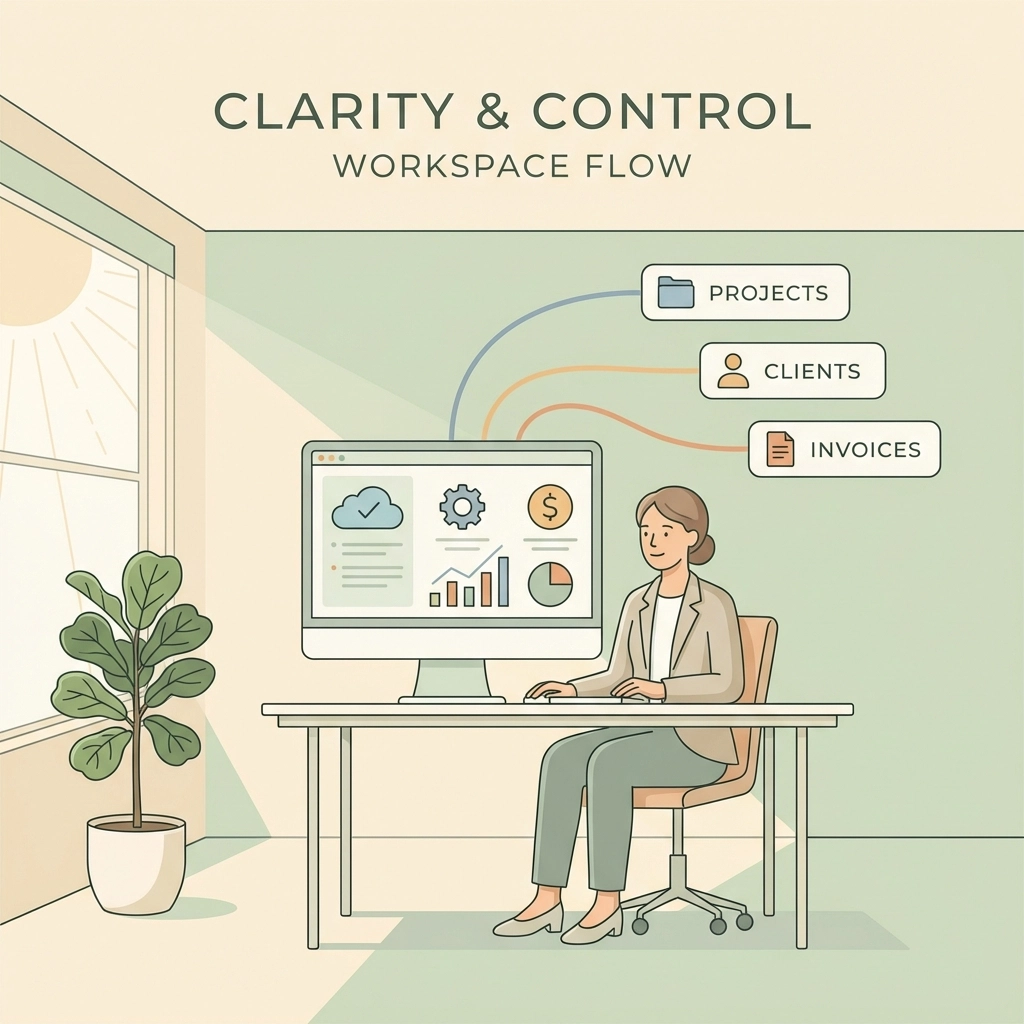
Imagine a business where everything lives in one place. Projects. Clients. Invoices. Communication. Files. Schedules. All connected. All synchronized.
That's the Architect approach.
Instead of bolting random tools together, you design your operations around a unified system. One login. One source of truth. One monthly bill.
Here's what changes:
-
Finding information takes seconds, not minutes. Everything is where you expect it to be.
-
Your data stays consistent. Update a client's email once. It updates everywhere.
-
Your team actually uses the tools. Because there's only one to learn.
-
Your costs become predictable. No more surprise charges from five different vendors.
-
Scaling gets easier. Add new team members without adding new complexity.
The Architect approach isn't about having fewer features. It's about having smarter features that work together.
Frankenstein vs. Architect: A Side-by-Side Look
| The Frankenstein Way | The Architect Way |
|---|---|
| 6+ monthly subscriptions | One unified platform |
| Data scattered across tools | Single source of truth |
| Hours wasted switching apps | Seamless workflows |
| Training takes weeks | Onboarding takes days |
| Integrations break constantly | Built-in connections |
| Support from multiple vendors | One team has your back |
The difference isn't subtle. It's transformational.
How to Move From Monster to Masterpiece
Ready to stop the madness? Here's a simple roadmap.
Step 1: Audit Your Current Stack
List every tool your business uses. Every single one. Include the free ones. Include the ones "only Sarah uses."
Now ask: What does each tool actually do? Where does the data go? What does it cost?
You'll probably find overlap. You'll definitely find waste.
Step 2: Identify Your Core Needs
Strip away the noise. What does your business actually need to operate?
For most small businesses, it comes down to:
- Managing projects and tasks
- Tracking clients and contacts
- Sending invoices and quotes
- Communicating with your team
- Storing and sharing files
That's it. Five core functions. You don't need 40 apps for that.
Step 3: Find Your Unified Platform
Look for a system that handles your core needs in one place. Not through janky integrations. Natively.
This is where platforms like TeamsMaster come in. Instead of stitching together a monster, you get a clean, unified system built for how businesses actually work.
Step 4: Migrate Gradually
You don't have to burn everything down overnight. Start with one function. Move your projects over. Get comfortable. Then migrate your client data. Then invoicing.
Small steps prevent big headaches.
Step 5: Cancel the Extras
Once you've moved, start canceling those old subscriptions. This is the satisfying part. Watch your software costs drop. Watch your team's productivity rise.
The Bottom Line
Your software should work for you. Not against you.
The Frankenstein approach feels efficient at first. Each tool solves a problem. But over time, the patchwork becomes a burden. Complexity grows. Costs climb. Productivity suffers.
The Architect approach takes a different path. One unified system. One source of truth. One login. Everything connected.
It's not about doing less. It's about doing more with less friction.
Your business deserves better than a monster made of mismatched parts. It deserves a system designed with intention.
So take a look at your software stack. Count the tabs. Add up the subscriptions. Notice the frustration.
Then ask yourself: Am I building a Frankenstein, or am I building something that actually works?
The answer might just change everything.