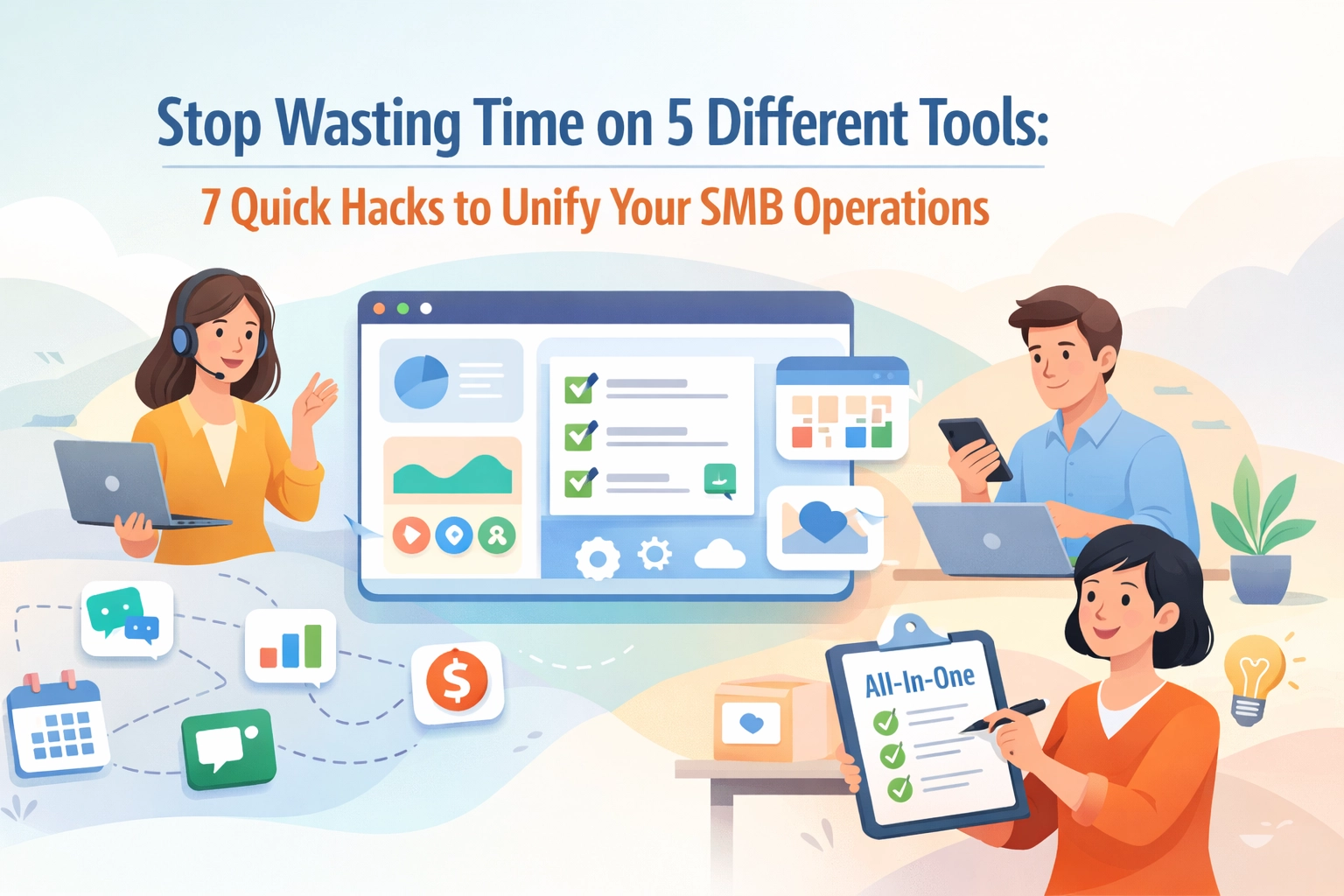
You've got one tool for tracking projects. Another for managing your team's time off. A third for customer relationships. Maybe a fourth for internal requests.
Sound familiar?
If you're running a small or mid-sized business, you've probably assembled a digital toolbox over the years. Each tool solved a problem at the time. But now? You're drowning in tabs, logins, and monthly subscriptions.
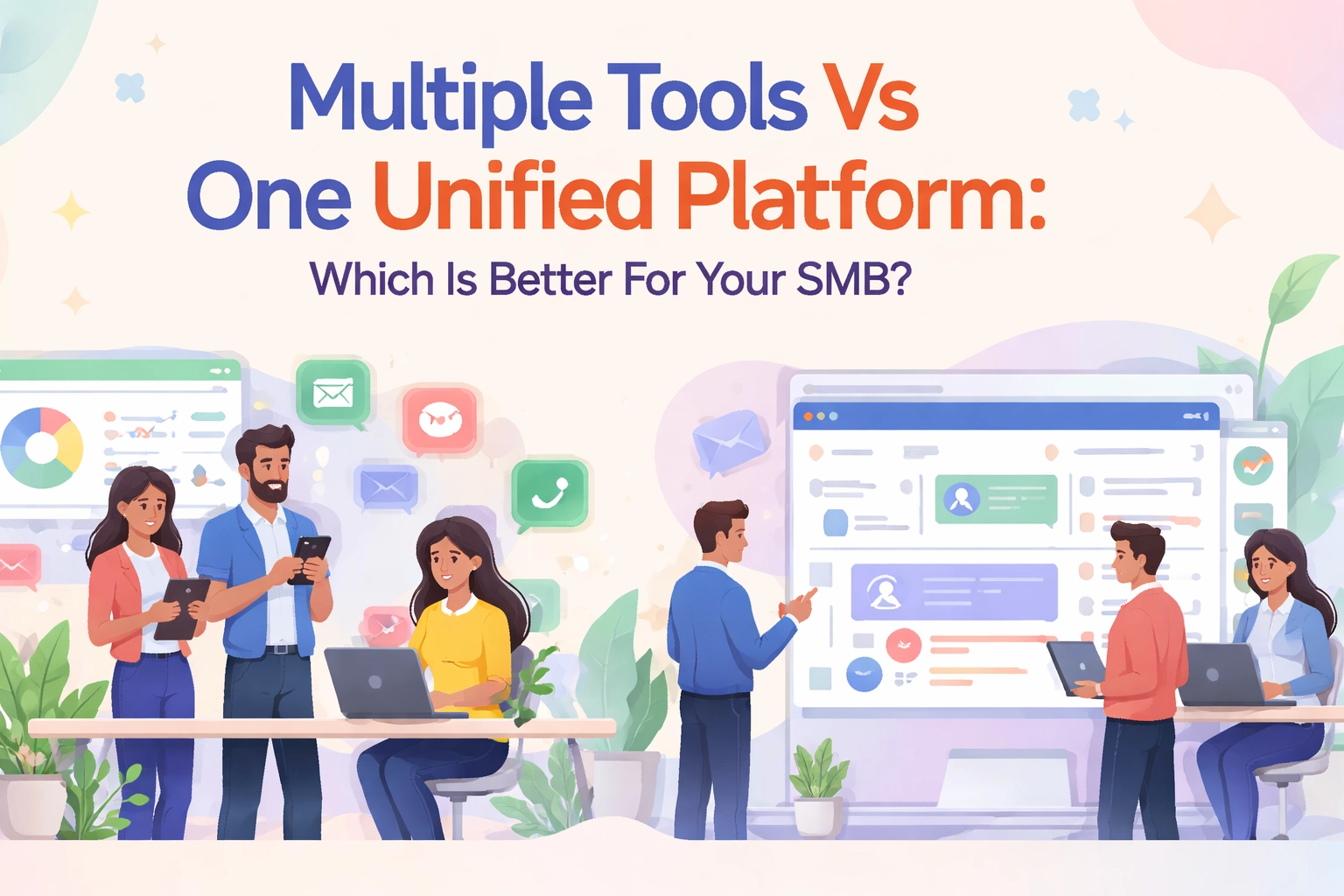
Here's the big question: Should you keep juggling multiple tools, or is it time to consolidate into one unified platform?
Let's break it down.
The Multiple Tools Reality
Let's be honest. Most SMBs don't choose to use ten different tools. It just happens.
You start with a free project tracker. Then you add a CRM when sales pick up. HR gets their own system when the team grows. Before you know it, you're managing a patchwork of software that barely talks to each other.
The result?
- Data lives everywhere. Customer info in one place. Employee records in another. Project updates scattered across three apps.
- Your team wastes time switching. Studies show context-switching kills productivity. Every time someone jumps between tools, focus takes a hit.
- Integration headaches pile up. Getting tools to sync requires workarounds, Zapier recipes, or expensive custom development.
- Costs add up fast. Each subscription seems small. But multiply that by five or ten tools? Your software bill gets ugly.

For lean teams, this friction compounds. You don't have a dedicated IT person to manage all these systems. You're the CEO, the project manager, and the IT department rolled into one.
What Does "Unified Platform" Actually Mean?
A unified platform brings your core business functions under one roof. We're talking about HR, CRM, and project management working together in a single system.
No more jumping between apps. No more copying data from one tool to another. No more wondering if your sales team and operations team are looking at the same information.
Here's what changes:
- One login. Your team accesses everything from a single dashboard.
- Shared data. Customer information flows into projects. Employee availability shows up in resource planning. Everything connects.
- Consistent experience. Everyone learns one interface. Onboarding gets simpler. Training takes days instead of weeks.
Think of it like moving from a cluttered desk with papers everywhere to a clean, organized workspace. Same information. Way easier to find and use.
The Unified Advantage for SMBs
So why are more small businesses making the switch? The benefits are real: and they compound over time.
Lower Total Cost
Here's a number that matters: unified platforms typically reduce licensing costs through consolidated agreements and bulk pricing. Instead of paying five vendors, you pay one. Instead of five renewal dates, you track one.
But the savings go deeper. Less time troubleshooting integration issues means less downtime. Fewer systems to manage means lower operational overhead.
Faster Onboarding
When a new hire joins your team, how long does it take before they're productive?
With multiple tools, they need to learn each system. Different logins. Different interfaces. Different ways of doing things.
With a unified platform? One system to master. New team members get up to speed faster. That's time and money back in your pocket.

Better Visibility
Ever had to chase three different people to get a complete picture of a project?
Unified platforms give you real-time visibility without the detective work. See what's happening with customers, projects, and your team: all in one view.
No more piecing together reports from different sources. No more surprises because data was siloed in someone else's tool.
Easier Scaling
Your business is growing. That's great. But growth gets complicated when you're managing a dozen different tools.
Standardized systems make it simpler to add new users, open new locations, or launch new services. You're not rebuilding your tech foundation every time you expand.
The unified advantage isn't just about today. It's about building a foundation that grows with you.
When Multiple Tools Might Still Make Sense
Let's be balanced here. Unified platforms aren't magic. There are situations where keeping specialized tools makes sense.
You have a critical legacy system. Maybe your accounting software has years of historical data and deep integrations with your bank. Ripping it out would cause more problems than it solves.
You need best-in-class for specific functions. Some industries require specialized tools. If you're in healthcare, for example, you might need compliance-specific software that no all-in-one platform covers.
Your workflows are highly unique. If your business operates in a way that no unified platform supports well, forcing a switch could create gaps.

In these cases, the goal shifts. You're not eliminating all tools: you're reducing tool sprawl where it makes sense. Keep what's essential. Consolidate the rest.
And when you do keep multiple tools, prioritize ones that integrate well. APIs and webhooks can bridge the gap between systems that need to stay separate.
How to Decide What's Right for Your Business
Not sure which path to take? Ask yourself these questions:
1. How much time does your team spend switching between tools?
Track it for a week. You might be shocked at how much productivity leaks out through tool-hopping.
2. How often do you deal with data inconsistencies?
If you regularly find conflicting information across systems, that's a red flag. Unified data means unified truth.
3. What's your real software spend?
Add up every subscription. Include the hidden costs: time spent on integrations, training, and troubleshooting. Compare that to what a unified platform would cost.
4. Can your current setup scale?
Picture your business in two years. Will your current tools support that growth? Or will they become bottlenecks?
5. What matters most to your team?
Sometimes the best insights come from the people using the tools daily. Ask them where they feel friction.
Making the Switch (Without the Chaos)
If you've decided a unified platform is right for your SMB, here's how to make the transition smooth:
Start with your core functions. Don't try to migrate everything at once. Begin with HR, CRM, and project management: the areas that touch the most of your business.
Clean your data first. Moving messy data into a new system just creates a new mess. Take time to organize, deduplicate, and standardize before you migrate.
Train your team properly. The best platform in the world fails if nobody knows how to use it. Invest in onboarding and give people time to adjust.
Run parallel for a bit. Keep your old systems accessible during the transition. This gives you a safety net while everyone gets comfortable.

Celebrate quick wins. When someone saves time with the new system, share it. Momentum builds buy-in.
The Bottom Line
Multiple tools served you well when you were getting started. But as your SMB grows, that patchwork approach creates drag.
A unified platform: one that brings HR, CRM, and project management together: simplifies your operations. It saves money. It saves time. It gives you visibility you can't get from scattered systems.
That's the Unified Advantage.
Of course, every business is different. You might have specialized needs that require keeping certain tools separate. That's fine. The goal isn't perfection: it's progress.
But if you're tired of the tab chaos, the subscription creep, and the constant context-switching? It might be time to consolidate.
Your team will thank you. Your budget will thank you. And future-you will definitely thank you.
Ready to see what a unified platform could do for your business? TeamsMaster brings HR, CRM, and project management together in one simple system built for growing SMBs.