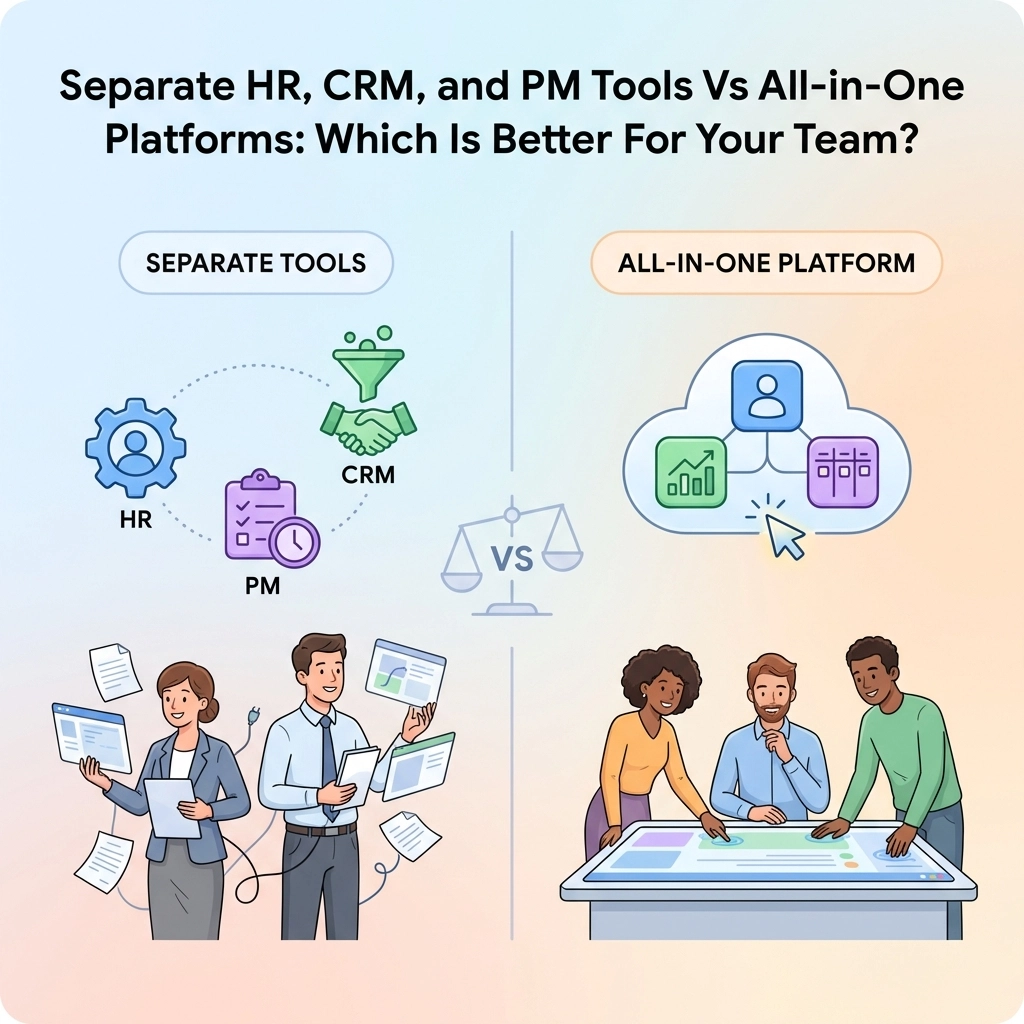
You're running your business from six different apps. Maybe seven.
There's one for tracking projects. Another for managing your team's time off. A spreadsheet for client contacts. And that CRM you bought last year? It's collecting digital dust.
Sound familiar?
Here's the thing. You didn't set out to build a Frankenstein tech stack. It just happened. One tool at a time. One problem at a time.
But now your team spends more time switching between platforms than actually getting work done.
It's exhausting. And it's costing you money.
Let's talk about why unified business management is the game-changer your team needs.
The Hidden Cost of Disconnected Systems
Every time your team jumps between tools, something gets lost.
Context. Time. Sanity.
Your sales rep closes a deal in the CRM. But your project manager doesn't see it for three days. Your HR lead is tracking employee performance in a spreadsheet. Meanwhile, project data lives somewhere else entirely.

The result? Silos everywhere.
Departments working in isolation. Data scattered across platforms. And you? You're stuck playing detective. Piecing together information from five different sources just to answer a simple question.
Disjointed systems create costly inaccuracies. They add operational complexity you don't need. And they slow down the decisions that actually move your business forward.
Your team deserves better. So does your bottom line.
What Unified Business Management Actually Means
Let's clear something up.
Unified business management isn't about cramming every feature into one bloated platform. It's about connection. Integration. Flow.
It means your HR data talks to your project management. Your CRM syncs with your team scheduling. Everything works together: like it should.
Think of it as a single source of truth for your entire operation.
- One place to see project progress.
- One place to track employee performance.
- One place to manage client relationships.
No more hunting through tabs. No more "let me check another system." No more conflicting reports that make you question everything.
When your tools work together, your team works better.
The Unified Advantage: Why SMBs Win Big
Big companies have entire IT departments to manage their tech stack. They can afford the complexity.
You can't. And honestly? You shouldn't have to.
Small and mid-sized businesses thrive on agility. You need to move fast. Adapt quickly. Make decisions without waiting for data to trickle in from five different platforms.

That's where the Unified Advantage comes in.
When your business management is unified, you get:
Speed. Decisions happen faster when information flows freely. No bottlenecks. No waiting.
Clarity. One dashboard. One view. One version of the truth. You see exactly what's happening across your entire business.
Growth. Time saved on admin work becomes time spent on revenue-driving activities. Your team focuses on what actually matters.
For SMBs, unified management isn't a luxury. It's a competitive edge.
Breaking Down Silos Between HR, CRM, and Projects
Here's where things get exciting.
Most businesses treat HR, sales, and project management as separate worlds. Different teams. Different tools. Different priorities.
But they're not separate at all. They're deeply connected.
Think about it:
- Your project success depends on having the right people. That's HR.
- Your revenue depends on strong client relationships. That's CRM.
- Your delivery depends on organized execution. That's project management.
When these systems talk to each other, magic happens.
Your project manager sees which team members have availability: without emailing HR. Your sales team knows project timelines: without chasing down updates. Your HR lead understands workload distribution: without building another spreadsheet.

Cross-functional alignment creates a seamless experience. For your team. For your clients. For everyone.
This is what unified business management looks like in action.
Real Benefits You'll Actually Feel
Let's get practical. What does this mean for your day-to-day?
Less Time on Admin, More Time on Growth
Automation handles the busywork. Data syncs automatically. Reports generate themselves.
Your team stops wrestling with manual processes. They start focusing on customers, projects, and strategy.
Fewer Errors, Better Accuracy
When data lives in one place, mistakes drop dramatically.
No more duplicate entries. No more outdated information floating around. No more "wait, which version is correct?"
Consistent, accurate information across every department.
Faster, Smarter Decisions
You don't need to schedule a meeting just to get a status update.
Real-time visibility means you see problems before they become crises. You spot opportunities before they disappear. You lead with confidence instead of guesswork.
Happier Teams
Here's one people forget.
Your team didn't sign up to manage software chaos. They want to do meaningful work. When you remove friction from their day, engagement goes up. Frustration goes down.
That's a win for everyone.
What to Look for in a Unified Platform
Not all "all-in-one" platforms deliver on the promise.
Some are just bundled tools with no real integration. Others are so complex they require a PhD to operate.
Here's what actually matters:
True integration. Data should flow between modules automatically. HR, CRM, and projects working as one system: not three separate tools in a trench coat.
Simplicity. Your team should understand it in days, not months. Clean interface. Clear workflows. No unnecessary complexity.
Flexibility. Your business is unique. Your platform should adapt to how you work, not the other way around.
Visibility. Dashboards that show you what matters. Reports that answer real questions. Insights you can act on immediately.

The goal is simple: one platform that helps you run your entire team. Without the headaches.
Making the Switch: Easier Than You Think
Change feels scary. Especially when your current setup "kind of works."
But here's the truth.
Every day you spend in a disconnected system costs you. Time. Money. Opportunities.
The switch to unified management doesn't have to be painful. Start small. Identify your biggest friction points. Look for a platform that solves those first.
Most teams see immediate wins. Faster onboarding. Clearer communication. Better project tracking from day one.
The businesses that embrace unified management now will outpace those that don't. It's not a matter of if: it's when.
Your Team Deserves Better
You started your business to build something great. Not to manage a tangled mess of disconnected tools.
Unified business management gives you back control. It gives your team clarity. It gives your business room to grow.
One platform. One source of truth. One smarter way to work.
Ready to see what the Unified Advantage can do for you? TeamsMaster brings HR, CRM, and project management together in one simple platform built for growing teams.
Your future self will thank you.