Let's be real for a second.
You've got your HR tool. Your CRM. Your project management app. Maybe a time tracker. An invoicing system. And that random spreadsheet Susan from accounting swears by.
Sound familiar?
If you're running a small or medium-sized business, you're probably juggling five, six, or even ten different platforms just to keep things moving. And here's the kicker: they don't talk to each other.
This is exactly why unified business platforms are having a moment. Everyone from startup founders to seasoned business owners is finally asking: "Why am I paying for all these tools when one platform could do the job?"
Great question. Let's dig in.
The Real Problem: Your Data Is Trapped in Silos
Here's a stat that might sting a little.
81% of enterprise leaders say their data is trapped in silos across departments and cloud systems. That's not just a big-company problem. SMBs feel this pain even harder.
Think about it. Your sales team closes a deal in the CRM. But your project team doesn't see it until someone sends a Slack message. Meanwhile, HR is onboarding a new hire in a completely separate system. And finance? They're waiting on three different exports to reconcile payroll.

Every tool is its own island. And you? You're stuck playing messenger between them.
This fragmentation slows you down. It creates confusion. It leads to missed opportunities and frustrated employees. Worst of all, it makes it nearly impossible to see the full picture of your business.
What Exactly Is a Unified Business Platform?
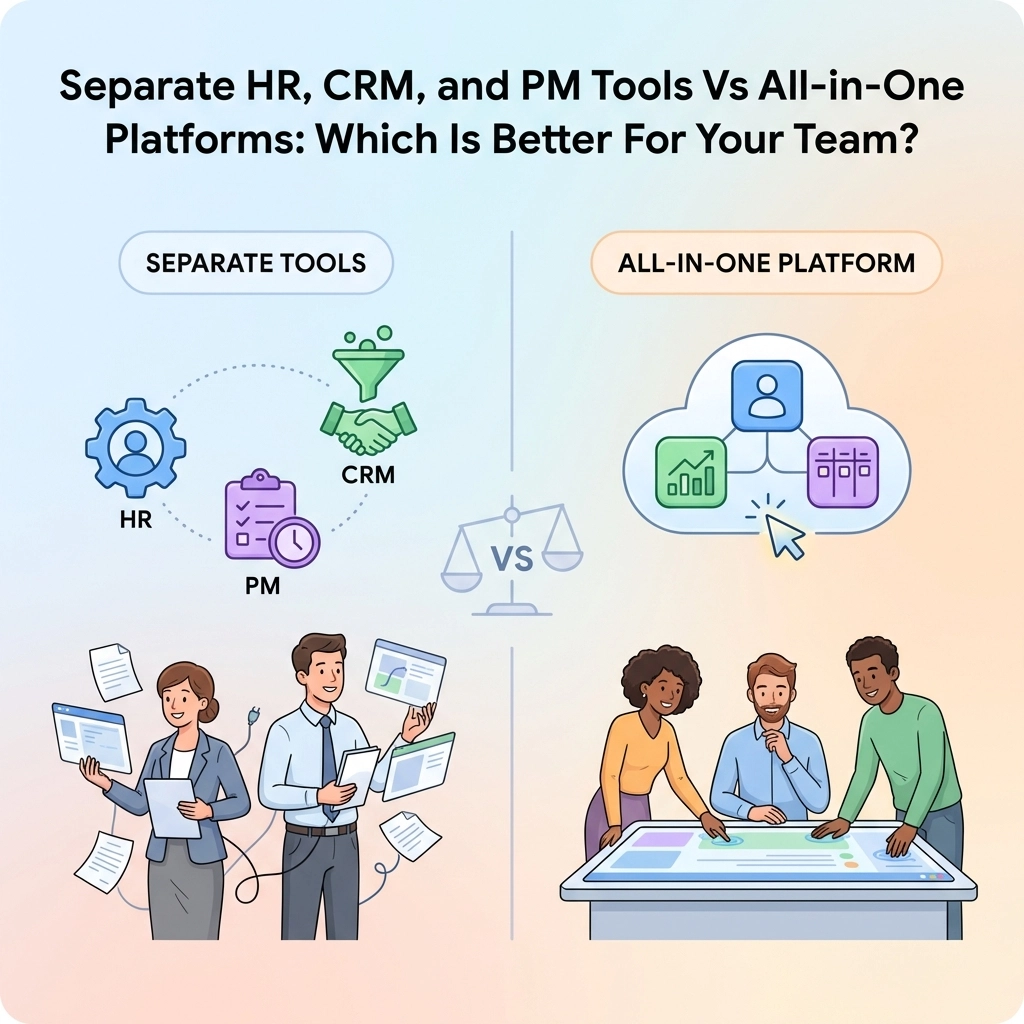
A unified business platform brings your core operations under one roof.
We're talking HR, CRM, and project management: all working together in a single system. No more switching tabs. No more duplicate data entry. No more "I thought you sent that."
Instead, you get:
- One source of truth. Everyone works from the same data.
- Seamless workflows. Information flows naturally between teams.
- Clearer insights. You see how everything connects: in real time.
It's not about having one tool that does everything poorly. It's about having one platform that does the essential things really well: and connects them intelligently.
Why SMBs Are Leading the Charge
Big corporations have been chasing integration for years. They've got IT teams, consultants, and custom-built solutions.
But here's what's changed.
Now, SMBs have access to the same unified advantage: without the enterprise price tag or complexity.

For growing businesses, this is a game-changer. You don't have the time or budget to manage a dozen subscriptions. You need tools that work together from day one.
Unified platforms let you:
- Scale without chaos. Add new team members without onboarding them to ten different apps.
- Stay lean. One platform means fewer licenses, fewer support tickets, fewer headaches.
- Move faster. When your data flows freely, decisions happen quickly.
And the numbers back this up. Businesses that consolidate into unified platforms report approximately $29,300 in annual savings per $100 million in revenue. That's real money back in your pocket.
The Unified Advantage: What You Actually Gain
Let's break down the benefits that matter most for your day-to-day operations.
1. Faster, Smarter Decisions
When your HR data, client relationships, and project timelines live in the same place, patterns emerge. You can spot trends. You can forecast accurately. You can act: not react.
No more waiting for three departments to send reports. The information is already there.
2. Streamlined Operations
Redundancies disappear. Bottlenecks shrink. Your team stops doing busywork and starts doing actual work.
Consolidating multiple tools into one platform can cut licensing and support overhead by up to 50%. That's not just cost savings. That's time savings. Energy savings. Sanity savings.
3. Better Team Collaboration
When everyone's on the same platform, communication improves naturally.
Sales can see project status. Project managers can see client history. HR can see workload distribution. No one's working in the dark anymore.

4. Happier Customers
Here's something that often gets overlooked.
Unified platforms give you comprehensive analytics across every touchpoint. You understand your customers better. You personalize your approach. You deliver faster.
Happy customers stick around. They refer others. They become your best marketing channel.
5. Reduced Risk
Data silos don't just slow you down: they create risk. Outdated information. Compliance gaps. Security vulnerabilities.
A unified system keeps everything current and controlled. You know where your data is. You know who's accessing it. You sleep better at night.
Signs You Need to Make the Switch
Still not sure if a unified platform is right for you? Here are some telltale signs:
- You're constantly copying data between systems.
- Your team asks "where do I find that?" multiple times a day.
- Reports take hours (or days) to compile.
- Onboarding new employees feels like a scavenger hunt.
- You're paying for features you never use across multiple tools.
- Different departments have different "versions" of the truth.
If any of these hit close to home, it might be time to simplify.
How TeamsMaster Brings It All Together
This is where TeamsMaster comes in.
We built TeamsMaster specifically for SMBs who want the unified advantage without the enterprise complexity. HR, CRM, and project management: all in one clean, simple platform.

Here's what that looks like in practice:
- HR tools that help you manage employees, track time, and handle leave requests.
- CRM features that keep your client relationships organized and accessible.
- Project management that lets you assign tasks, track progress, and hit deadlines.
Everything connects. Everything syncs. And everything just works.
No more juggling apps. No more "let me check the other system." No more chaos.
Just clarity.
The Bottom Line
Unified business platforms aren't just a trend. They're a smarter way to run your business.
For SMBs especially, the benefits are hard to ignore. You save money. You save time. You empower your team to do their best work.
And when your HR, CRM, and project management all speak the same language? Growth becomes a whole lot easier.
The conversation around unified platforms is only getting louder. The question isn't whether you should pay attention.
It's whether you can afford not to.
Ready to see the unified advantage for yourself? Check out TeamsMaster and discover how simple business management can really be.