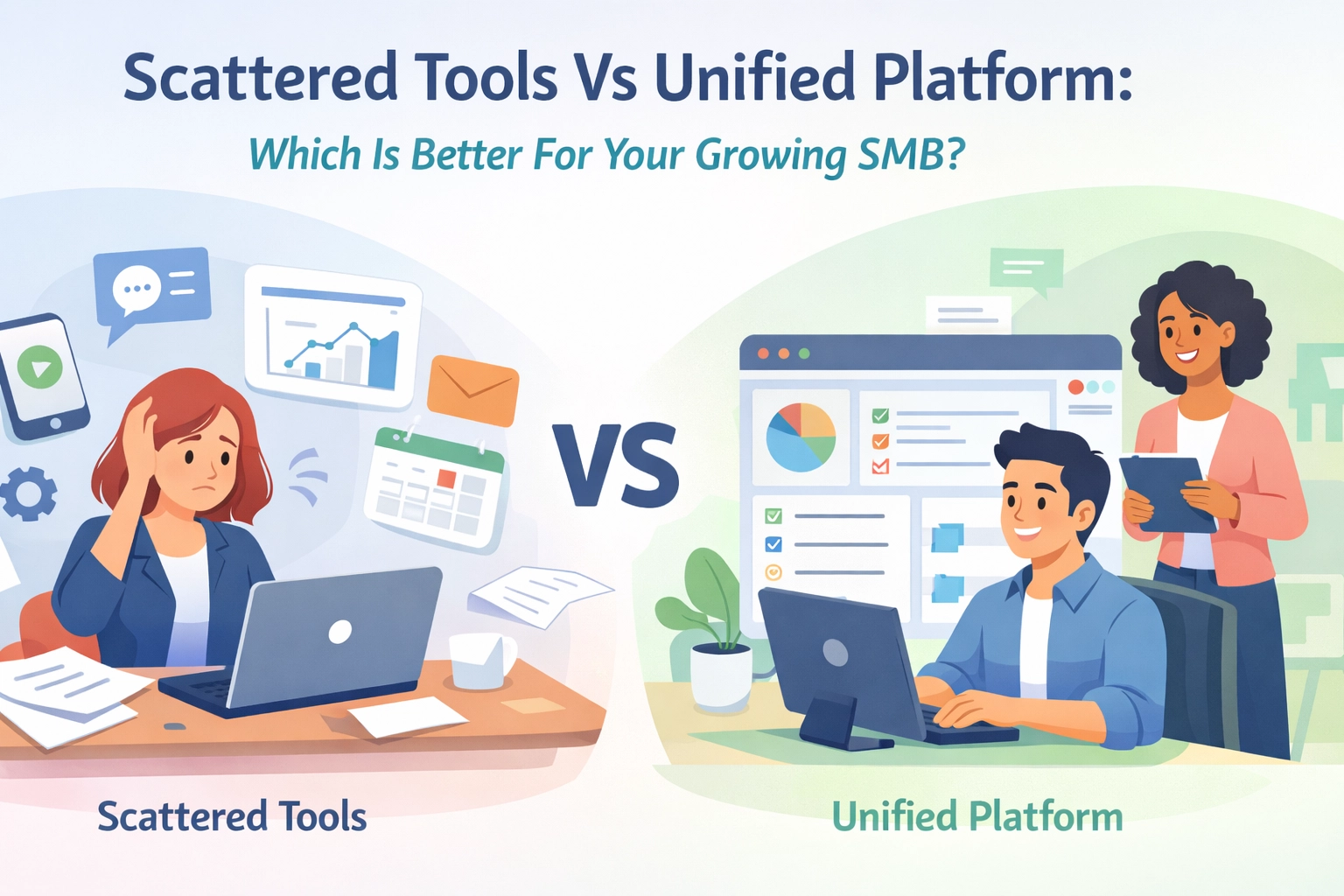
Your morning routine probably looks something like this:
Check Slack. Open your CRM. Switch to the project management tool. Log into the HR platform. Maybe pop into a spreadsheet or two.
Before you've had your second coffee, you've already toggled between five different apps. Sound familiar?
You're not alone. Most small and mid-sized businesses run on a patchwork of disconnected tools. Each one promises to make life easier. Together? They create chaos.
Here's the good news. It doesn't have to be this way.
The Hidden Cost of App Juggling
Let's talk about what all that switching actually costs you.
Time. Every toggle between apps eats up seconds. Those seconds add up. Studies show the average worker loses over an hour daily just switching contexts. That's five hours a week. Gone.
Money. Five subscriptions. Five billing cycles. Five sets of features you're probably not fully using. It adds up faster than you'd think.
Sanity. Where did that customer note go? Was it in the CRM or the project tool? Did Sarah update the HR system or just send an email? The mental load of tracking information across platforms is exhausting.

Data silos. This is the big one. When your HR system doesn't talk to your project management tool, you can't see the full picture. Your sales team doesn't know what projects are in flight. Your project managers don't know who's on PTO next week.
Information gets stuck. Decisions get delayed. Opportunities slip through the cracks.
For growing SMBs, these inefficiencies aren't just annoying. They're growth killers.
What Unification Actually Looks Like
So what's the alternative?
Imagine one platform where everything connects. Your customer data flows into your project workflows. Your HR records inform resource allocation. Your sales pipeline syncs with your delivery team.
No more manual data entry. No more hunting for information. No more "let me check the other system."
This is unified business management. And it's changing how smart SMBs operate.
The Core Pillars
A truly unified system brings together three critical functions:
HR Management
- Employee records and onboarding
- Time tracking and attendance
- Performance monitoring
- Leave management
CRM (Customer Relationship Management)
- Contact and lead management
- Sales pipeline tracking
- Customer communication history
- Deal forecasting
Project Management
- Task assignment and tracking
- Resource allocation
- Timeline and milestone management
- Team collaboration

When these three pillars connect, magic happens.
Your project manager can instantly see which team members are available. Your sales rep can check project status before hopping on a client call. Your HR team can track how employee performance ties to project outcomes.
Everything works together. Like it should.
The Unified Advantage for Growing SMBs
Here's why this matters especially for small and mid-sized businesses.
You don't have the luxury of dedicated teams for every function. Your operations manager might also handle HR. Your sales lead might jump into project delivery. People wear multiple hats.
Disconnected tools make this harder. Unified platforms make it possible.
Single Source of Truth
Stop asking "which version is correct?" With unified data, everyone works from the same information. Customer details update once and sync everywhere. No duplicates. No conflicts. No confusion.
Faster Decision Making
Need to know if you can take on a new client project? Check resource availability, current workload, and upcoming PTO: all in one view. Decisions that used to take days now take minutes.
Streamlined Workflows
Automate the boring stuff. When a deal closes in CRM, automatically create the project workspace. When a new hire joins, assign them to relevant projects based on their role. Let the system do the heavy lifting.

Better Visibility
Dashboards that actually mean something. See your sales pipeline, project health, and team capacity in one place. Spot bottlenecks before they become problems. Track growth metrics without building spreadsheet nightmares.
Reduced Costs
One platform. One subscription. One learning curve. You'll spend less on software and less time training your team on multiple systems.
How to Make the Switch Today
Ready to ditch the app chaos? Here's your game plan.
Step 1: Audit Your Current Stack
List every tool your team uses daily. Be honest: include those random spreadsheets and the app someone signed up for "just to try."
For each tool, note:
- What it does
- How much it costs
- Who uses it
- What data lives there
You'll probably be surprised by the overlap. And the gaps.
Step 2: Identify Your Must-Haves
Not every feature matters equally. Talk to your team. What do they actually need?
Focus on the functions that impact your daily operations:
- Contact management
- Task tracking
- Employee records
- Reporting and analytics
- Team communication
Rank them. This becomes your shopping list.
Step 3: Choose Your Unified Platform
Look for solutions that natively integrate HR, CRM, and project management. All-in-one platforms eliminate integration headaches and ensure your data flows smoothly.
TeamsMaster is built exactly for this. It brings together everything SMBs need: without the complexity of enterprise software or the limitations of cobbled-together tools.

Step 4: Plan Your Migration
Don't try to move everything at once. Start with one function: maybe your CRM data. Get comfortable. Then add HR records. Then project workflows.
Most unified platforms offer import tools and migration support. Use them.
Step 5: Train Your Team
The best software is useless if nobody uses it. Invest time in proper onboarding. Show your team the benefits. Make it easy to ask questions.
Pro tip: identify one or two "champions" who learn the system deeply. They become your internal support squad.
Step 6: Iterate and Optimize
Your first setup won't be perfect. That's okay.
After a month, check in. What's working? What's clunky? Adjust your workflows. Customize your dashboards. The goal is a system that fits your business: not the other way around.
Real Benefits, Real Results
What can you expect after unifying your tools?
Eliminated manual data entry. Information flows automatically between functions.
Prevented data silos. Everyone sees the same picture.
Automatic syncing. Contact details, project updates, and employee records stay current.
Unified visibility. One dashboard for your entire operation.
Teams using unified platforms report spending less time on admin tasks. They make faster decisions. They feel less stressed.
And for growing SMBs? That efficiency translates directly into capacity for growth. You can take on more clients, more projects, more opportunities: without adding more chaos.
Your Next Move
You started today juggling five apps. You don't have to end the week the same way.
Unified business management isn't some far-off dream. It's available now. Platforms like TeamsMaster are built specifically for SMBs who want simplicity without sacrificing power.
One platform. All your HR, CRM, and project management needs. Connected.
No more context switching. No more data hunting. No more app fatigue.
Just your business, running smoothly.
That's the Unified Advantage. And it's waiting for you.